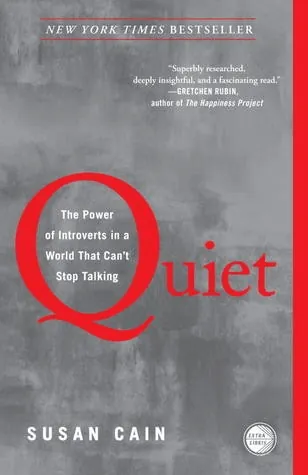
Quiet: The Power of Introverts in a World That Can't Stop Talking
by Susan Cain
Listen to it free. Get Quiet on Audible with a 30-day trial — cancel anytime.
Start listening freeon AudibleNew members only · many titles are included with the membership. As an Amazon Associate, Read Stacks earns from qualifying purchases and membership trials at no extra cost to you.
What this book is, and who it's for
Susan Cain's 2012 book is a quiet revolution in how a culture optimized for extroverts thinks about its other half. Drawing on developmental psychology, neuroscience, and case studies from Lincoln to Eleanor Roosevelt to modern tech leaders, Cain documents the costs the Extrovert Ideal has imposed on schools, workplaces, and individuals — and the contributions introverts make that the dominant cultural script renders invisible. The book is neither a complaint nor a self-help manual; it is the careful argument that one-third to one-half of the population has been told to perform a personality that does not fit, and that the cost is measurable in burned-out workers, suppressed children, and creative breakthroughs that never happened in noisy open offices. Read this if you've ever felt you were doing something wrong by needing solitude.
A person who recharges through solitude and processes information through deep reflection rather than external stimulation. Cain's argument: modern workplaces optimize for extroverted thinking-style at significant cost to creative output.
How to apply Quiet in 3 steps
- 1Audit your energy patterns honestly
Track for two weeks: what activities recharge you and what activities drain you? If solitude recharges and social gatherings drain, you're operating on an introvert wiring. The diagnosis is the precondition for the design that follows.
- 2Design your work week around your wiring
If you're an introvert, the productive day-pattern is usually: a few hours of deep solo work, one or two scheduled interactions, more deep work, recovery time. If you're an extrovert: more interaction throughout, less solo blocks. Either way, design rather than default.
- 3Engineer the space, not just the time
Open offices are introvert-hostile. If you can't change the space, claim a corner, use noise-canceling headphones, work from home certain days. Cain's research is clear that environment shapes thinking-style outputs as much as willpower does.
Chapters
- Chapter 1The Rise of the Extrovert Ideal1.5 min
- Chapter 2The Myth of Charismatic Leadership1.5 min
- Chapter 3When Collaboration Kills Creativity1.5 min
- Chapter 4Is Temperament Destiny?1.5 min
- Chapter 5Beyond Temperament: Free Will2 min
- Chapter 6Franklin Was a Politician, but Eleanor Spoke Out of Conscience1.5 min
- Chapter 7Why Cool Is Overrated2 min
- Chapter 8Soft Power1.5 min
- Chapter 9When Should You Act More Extroverted Than You Really Are?2 min
How to read this book. Each chapter is a ~30-second summary — the core insight, no filler. Open the chapters that grab you. If the book resonates, hear the full audiobook free with an Audible trial or buy the edition on Amazon (links below, affiliate-disclosed).
Quiet pairs well with
A single book is an argument. A stack is a curriculum. Quiet appears in this curated reading path — each pairs it with other books that sharpen its ideas, in a suggested reading order.
More books like Quiet
The other books in the curated reading paths Quiet belongs to. Each one sharpens, extends, or counter-argues something Quiet establishes — the compound is the reason these books sit together in a stack.
- Think clearlyThinking, Fast and SlowDaniel Kahneman
- Think clearlyPrinciplesRay Dalio
- Think clearlyOutliersMalcolm Gladwell
- Think clearlyMindsetCarol S. Dweck
- Think clearlyDriveDaniel H. Pink
- Think clearlyThe Psychology of MoneyMorgan Housel
- Think clearlyRangeDavid Epstein
- Think clearlyPredictably IrrationalDan Ariely
Frequently asked questions
What is Quiet about?+
Susan Cain's 2012 book is a quiet revolution in how a culture optimized for extroverts thinks about its other half.
How long does it take to read Quiet?+
The full Quiet typically takes 4-6 hours to read cover-to-cover. The Read Stacks chapter summaries cover the same ideas in ~15.5 minutes total (9 chapters at ~30 seconds each).
Who is Quiet for?+
Quiet is for readers curious about why people think and decide the way they do. Useful for designers, marketers, negotiators, and anyone making decisions with imperfect information.
What are the key ideas in Quiet?+
The book covers The Rise of the Extrovert Ideal, The Myth of Charismatic Leadership, When Collaboration Kills Creativity, Is Temperament Destiny? and Beyond Temperament: Free Will. Each chapter has a free summary on Read Stacks (~30 seconds each).
Is Quiet worth reading?+
If you're interested in the ideas in Quiet, Quiet is widely considered essential. The Read Stacks chapter summaries help you decide — read the free first chapter, then buy the full book on Amazon if the argument resonates.
Books like Quiet
If Quiet resonated, these non-fiction books pick up the same threads.

From Read Stacks · Learn
How to get more out of this book
Two short essays on the meta-skill — what chapter summaries actually preserve, and the six retention techniques that decide whether what you read here is still useful six months from now.
- Are book summaries actually useful, or am I just cheating?
Chapter summaries are a navigation tool, not a substitute. Used right, they help you read more books fully — by helping you avoid the wrong ones. Used wrong, they're a comfort blanket that lets you feel like you're reading without engaging with the material.
6 min read
- I read a lot of books but can't remember anything. What works?
Forgetting most of what you read is normal, not a personal failing — your brain wasn't designed to retain prose at the rate modern readers consume it. The practices that DO work share one thing: they force you to USE the material instead of just consuming it. Six specific techniques, each tested across decades.
7 min read
Appears in these topics
Quiet is part of this curated reading list — each a “best books on X” cluster with a synthesis on how the books fit together.
Want one curated stack a week in your inbox? Subscribe to the free weekly stack →