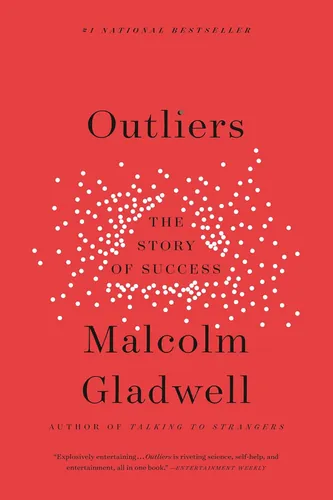
Outliers: The Story of Success
Published 200820 min read11 chapters
- First published
- 2008
- Core framework
- The 10,000-hour rule
- Reading time
- ≈ 20 min for all 11 chapter summaries (4,995 words)
Gladwell looks at what produces exceptional success, from the birth months of Canadian hockey players to the early careers of Bill Gates and the Beatles. (Source: Wikipedia)
Audible trial: new members only. As an Amazon Associate, Read Stacks earns from qualifying purchases and membership trials at no extra cost to you.
What this book is, and who it's for
Malcolm Gladwell's 2008 book demolishes the myth of pure individual talent by showing that success at the elite level is consistently — and uncomfortably — the visible top of a stack of cultural, generational, and circumstantial advantages. The 10,000-hours rule from this book got most of the attention, but the more durable argument is the broader pattern: when you ask 'why did this person succeed,' you usually find an answer in the question 'when and where were they born, and who taught them.' Read this if you've ever felt the impulse to attribute success to character — and want a more accurate model.
Gladwell's popularization of Anders Ericsson's research linking expert performance to roughly 10,000 hours of practice. Ericsson later corrected the framing: the quality of those hours (deliberate practice) matters more than the count.
How to apply Outliers in 3 steps
- 1Audit your own context advantages
Without pretending success is purely earned, identify the contextual advantages you've had — when you were born, who your parents are, what schools you attended, what jobs landed in your path by luck. The honest audit produces both gratitude and clarity about what's actually yours.
- 2Engineer context for those who don't have it
If you're in a position to provide context to others (manager, parent, mentor, founder of a team), examine what context you're providing. Cultural fit, demanding-but-fair feedback, opportunity to practice deliberately — these are the contextual advantages that compound, and you can deliberately engineer them.
- 3Sustain practice past the talent narrative
Outliers' deeper claim, which Ericsson refines: the difference between competent and great is sustained deliberate practice in a context that supports it. If you're competent at something and want greatness, the path is hours and conditions, not waiting for a talent gene to express.
Opening
Chapters
- Chapter 1The Matthew Effect2 min
- Chapter 2The 10,000-Hour Rule1.5 min
- Chapter 3The Trouble with Geniuses, Part 11.5 min
- Chapter 4The Trouble with Geniuses, Part 21.5 min
- Chapter 5The Three Lessons of Joe Flom1.5 min
- Chapter 6Harlan, Kentucky2 min
- Chapter 7The Ethnic Theory of Plane Crashes1.5 min
- Chapter 8Rice Paddies and Math Tests1.5 min
- Chapter 9Marita’s Bargain1.5 min
Closing & reference
How to read this book. Each chapter is a summary of about 1.8 minutes — the core insight, no filler. Open the chapters that grab you. If the book resonates, hear the full audiobook free with an Audible trial or buy the edition on Amazon (links below, affiliate-disclosed).
Outliers pairs well with
A single book is an argument. A stack is a curriculum. Outliers appears in 2 curated reading paths — each pairs it with other books that sharpen its ideas, in a suggested reading order.
More books like Outliers
The other books in the curated reading paths Outliers belongs to. Each one sharpens, extends, or counter-argues something Outliers establishes — the compound is the reason these books sit together in a stack.
- Think clearlyThinking, Fast and SlowDaniel Kahneman
- Think clearlyPrinciplesRay Dalio
- Think clearlyMindsetCarol S. Dweck
- Think clearlyDriveDaniel H. Pink
- Think clearlyQuietSusan Cain
- Think clearlyThe Psychology of MoneyMorgan Housel
- Think clearlyRangeDavid Epstein
- Think clearlyPredictably IrrationalDan Ariely
Frequently asked questions
What is Outliers about?+
Malcolm Gladwell's 2008 book demolishes the myth of pure individual talent by showing that success at the elite level is consistently — and uncomfortably — the visible top of a stack of cultural, generational, and circumstantial advantages.
How long does it take to read Outliers?+
The full Outliers typically takes 4-6 hours to read cover-to-cover. The Read Stacks chapter summaries cover the same ideas in ~20 minutes total (11 chapters at about 1.8 minutes each).
Who is Outliers for?+
Outliers is widely regarded as essential reading in its field. The Read Stacks summary is the fastest way to decide if the full book is worth your time before committing to it.
What are the key ideas in Outliers?+
The book covers The Matthew Effect, The 10,000-Hour Rule, The Trouble with Geniuses, Part 1, The Trouble with Geniuses, Part 2 and The Three Lessons of Joe Flom. Each chapter has a free summary on Read Stacks (about 1.8 minutes each).
Is Outliers worth reading?+
If you're interested in the ideas in Outliers, Outliers is widely considered essential. The Read Stacks chapter summaries help you decide — read the free first chapter, then buy the full book on Amazon if the argument resonates.
Books like Outliers
If Outliers resonated, these non-fiction books pick up the same threads.
From Read Stacks · Learn
How to get more out of this book
Three short guides: how to take notes on a non-fiction book, how to summarise a chapter in your own words, and the retention techniques that decide whether what you read here is still useful six months from now.
- How do I take notes on a non-fiction book?
Decide what the notes are for, read a full section before writing, and use the same short layout for every chapter: claim, reasons, evidence, terms and your own response, all in your own words with page numbers. Turn each note into questions for review, and finish with a one-page summary of the whole book.
5 min read
- How do I summarise a non-fiction chapter?
Read the chapter's opening and closing pages first, write its main claim as one sentence, list the two to four reasons the author gives and the best piece of evidence, then close the book and write a short paragraph from memory. Check it against the text and add one clearly labelled line of your own.
5 min read
- I read a lot of books but can't remember anything. What works?
Forgetting most of what you read is normal, not a personal failing — your brain wasn't designed to retain prose at the rate modern readers consume it. The practices that DO work share one thing: they force you to USE the material instead of just consuming it. Six specific techniques, each tested across decades.
7 min read
Appears in these topics
Outliers is part of 3 curated reading lists — each a “best books on X” cluster with a synthesis on how the books fit together.