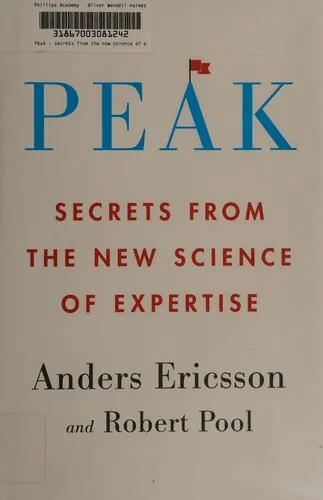
Peak: Secrets from the New Science of Expertise
Listen to it free. Get Peak on Audible with a 30-day trial — cancel anytime.
Start listening freeon AudibleNew members only · many titles are included with the membership. As an Amazon Associate, Read Stacks earns from qualifying purchases and membership trials at no extra cost to you.
What this book is, and who it's for
Anders Ericsson's 2016 book is the definitive summary of his thirty-year research career studying experts in chess, music, athletics, medicine, and other domains. The central argument is that extraordinary skill is built through a specific kind of practice — deliberate practice — that almost no one engages in by default, and that the conventional belief in innate talent is wrong in ways that matter for anyone trying to improve at anything. Deliberate practice has four properties (specific goals, focused attention, immediate feedback, working at the edge of current capability) and produces measurable changes in brain structure and mental representations across decades of consistent application. The book is careful about its claims — Ericsson is the researcher behind the famous 10,000-hours framing that Malcolm Gladwell popularized, and he is explicit that the hours alone do not produce expertise; the quality of those hours does. Read this when you've noticed that you've been doing something for years without getting noticeably better at it, or when you suspect that your default approach to skill development is producing repetition rather than improvement.
Practice with specific goals, focused attention, immediate feedback, and operating at the edge of current capability. Ericsson's research identifies it as the structural pattern underlying expert performance across every domain where expertise has been studied.
How to apply Peak in 3 steps
- 1Choose your domain and define expert performance
For the skill you want to develop, write down what expert performance specifically looks like — measurable, observable, distinguishable from competence. Without this definition, practice cannot be deliberate; it's just repetition with hope attached.
- 2Design deliberate practice sessions
Each session must have: (1) a specific goal at the edge of your current capability, (2) focused attention with no distractions, (3) feedback (a coach, a measurable output, or honest self-assessment), (4) opportunity to fail and adjust. If a practice session lacks any of these, it's the warm-up, not the work.
- 3Build mental representations through reflection
After each practice session, reflect: what did you do well, what failed, what specifically would you change next time? The reflection is what builds the rich mental representations that distinguish experts from competent performers. Hours of practice without reflection plateau; the same hours with reflection compound.
Opening
Chapters
- Chapter 1The Power of Purposeful Practice1.5 min
- Chapter 2Harnessing Adaptability1.5 min
- Chapter 3Mental Representations1.5 min
- Chapter 4The Gold Standard2 min
- Chapter 5Principles of Deliberate Practice on the Job1.5 min
- Chapter 6Principles of Deliberate Practice in Everyday Life1.5 min
- Chapter 7The Road to Extraordinary2 min
- Chapter 8How to Explain Natural Talent2 min
How to read this book. Each chapter is a ~30-second summary — the core insight, no filler. Open the chapters that grab you. If the book resonates, hear the full audiobook free with an Audible trial or buy the edition on Amazon (links below, affiliate-disclosed).
Peak pairs well with
A single book is an argument. A stack is a curriculum. Peak appears in this curated reading path — each pairs it with other books that sharpen its ideas, in a suggested reading order.
More books like Peak
The other books in the curated reading paths Peak belongs to. Each one sharpens, extends, or counter-argues something Peak establishes — the compound is the reason these books sit together in a stack.
- Build better habitsThe 7 Habits of Highly Effective PeopleStephen R. Covey
- Build better habitsThe Power of HabitCharles Duhigg
- Build better habitsAtomic HabitsJames Clear
- Build better habitsDeep WorkCal Newport
- Build better habitsEssentialismGreg McKeown
- Build better habitsGritAngela Duckworth
- Build better habitsSo Good They Can't Ignore YouCal Newport
Frequently asked questions
What is Peak about?+
Anders Ericsson's 2016 book is the definitive summary of his thirty-year research career studying experts in chess, music, athletics, medicine, and other domains.
How long does it take to read Peak?+
The full Peak typically takes 4-6 hours to read cover-to-cover. The Read Stacks chapter summaries cover the same ideas in ~16 minutes total (9 chapters at ~30 seconds each).
Who is Peak for?+
Peak is widely regarded as essential reading in its field. The Read Stacks summary is the fastest way to decide if the full book is worth your time before committing to it.
What are the key ideas in Peak?+
The book covers The Power of Purposeful Practice, Harnessing Adaptability, Mental Representations, The Gold Standard and Principles of Deliberate Practice on the Job. Each chapter has a free summary on Read Stacks (~30 seconds each).
Is Peak worth reading?+
If you're interested in the ideas in Peak, Peak is widely considered essential. The Read Stacks chapter summaries help you decide — read the free first chapter, then buy the full book on Amazon if the argument resonates.
Books like Peak
If Peak resonated, these non-fiction books pick up the same threads.
From Read Stacks · Learn
How to get more out of this book
Two short essays on the meta-skill — what chapter summaries actually preserve, and the six retention techniques that decide whether what you read here is still useful six months from now.
- Are book summaries actually useful, or am I just cheating?
Chapter summaries are a navigation tool, not a substitute. Used right, they help you read more books fully — by helping you avoid the wrong ones. Used wrong, they're a comfort blanket that lets you feel like you're reading without engaging with the material.
6 min read
- I read a lot of books but can't remember anything. What works?
Forgetting most of what you read is normal, not a personal failing — your brain wasn't designed to retain prose at the rate modern readers consume it. The practices that DO work share one thing: they force you to USE the material instead of just consuming it. Six specific techniques, each tested across decades.
7 min read
Appears in these topics
Peak is part of 3 curated reading lists — each a “best books on X” cluster with a synthesis on how the books fit together.
Want one curated stack a week in your inbox? Subscribe to the free weekly stack →