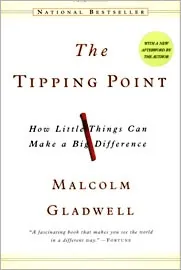
The Tipping Point: How Little Things Can Make a Big Difference
Listen to it free. Get The Tipping Point on Audible with a 30-day trial — cancel anytime.
Start listening freeon AudibleNew members only · many titles are included with the membership. As an Amazon Associate, Read Stacks earns from qualifying purchases and membership trials at no extra cost to you.
What this book is, and who it's for
Malcolm Gladwell's 2000 book is the one that put the phrase 'tipping point' into general circulation and gave a generation of marketers, public-health workers, and educators a shared vocabulary for thinking about social epidemics. The central argument is that ideas, products, and behaviors spread through populations the way viruses do — most spread is invisible until a small change crosses a threshold, after which the curve goes vertical. Gladwell maps three rules governing when the threshold is crossed: the Law of the Few (a small number of socially-unusual people do the bulk of the spreading), the Stickiness Factor (the message itself must be engineered to be remembered and acted upon), and the Power of Context (the environmental conditions surrounding the message determine whether it catches). The cases — Hush Puppies' revival, the 1990s drop in New York crime, Sesame Street's production studies, the spread of teen smoking — make the framework concrete enough that you'll start spotting tipping-point patterns in your own work within days of finishing the book. Read this when you've noticed that some of your ideas spread effortlessly and others die quietly despite being objectively better.
The threshold at which an idea, product, or behavior shifts from invisible spread to vertical growth. Gladwell identifies three rules governing when the threshold is crossed: the Law of the Few, the Stickiness Factor, and the Power of Context.
How to apply The Tipping Point in 3 steps
- 1Find your Connectors, Mavens, and Salesmen
For any idea you want to spread, the work is not broadcasting — it's identifying the rare people who do the spreading. Connectors who know everyone, Mavens who research deeply, Salesmen who persuade emotionally. Build relationships with these specific people first; they amplify in ways no broadcast can.
- 2Engineer stickiness into the message itself
Small message changes have outsized effects on whether ideas survive contact with audiences. Reduce, repeat, vary, concrete. Apply the SUCCESs framework. Pre-test on a small audience and watch which version they remember a week later — that's the stickiness signal you can engineer toward.
- 3Change context to change behavior
When direct persuasion fails, change the environment. Adding visible quitters changes smoking norms. Adding broken windows changes crime norms. For any behavior change you want, find one specific environmental cue you can modify, then watch the cascade.
Opening
Chapters
- Chapter 1The Law of the Few: Connectors, Mavens, and Salesmen1.5 min
- Chapter 2The Stickiness Factor: Sesame Street, Blue's Clues, and the Educational Virus1.5 min
- Chapter 3The Power of Context (Part One): Bernie Goetz and the Rise and Fall of New York City Crime2 min
- Chapter 4The Power of Context (Part Two): The Magic Number One Hundred and Fifty1.5 min
- Chapter 5Case Study: Rumors, Sneakers, and the Power of Translation1.5 min
- Chapter 6Case Study: Suicide, Smoking, and the Search for the Unsticky Cigarette2 min
Closing & reference
How to read this book. Each chapter is a ~30-second summary — the core insight, no filler. Open the chapters that grab you. If the book resonates, hear the full audiobook free with an Audible trial or buy the edition on Amazon (links below, affiliate-disclosed).
The Tipping Point pairs well with
A single book is an argument. A stack is a curriculum. The Tipping Point appears in this curated reading path — each pairs it with other books that sharpen its ideas, in a suggested reading order.
More books like The Tipping Point
The other books in the curated reading paths The Tipping Point belongs to. Each one sharpens, extends, or counter-argues something The Tipping Point establishes — the compound is the reason these books sit together in a stack.
- Influence with integrityHow to Win Friends and Influence PeopleDale Carnegie
- Influence with integrityInfluenceRobert Cialdini
- Influence with integrityNever Split the DifferenceChris Voss
- Influence with integrityPre-SuasionRobert Cialdini
- Influence with integrityMade to StickChip Heath & Dan Heath
- Influence with integrityCrucial ConversationsPatterson, Grenny, McMillan & Switzler
- Influence with integrityThe Laws of Human NatureRobert Greene
Frequently asked questions
What is The Tipping Point about?+
Malcolm Gladwell's 2000 book is the one that put the phrase 'tipping point' into general circulation and gave a generation of marketers, public-health workers, and educators a shared vocabulary for thinking about social epidemics.
How long does it take to read The Tipping Point?+
The full The Tipping Point typically takes 4-6 hours to read cover-to-cover. The Read Stacks chapter summaries cover the same ideas in ~14 minutes total (8 chapters at ~30 seconds each).
Who is The Tipping Point for?+
The Tipping Point is widely regarded as essential reading in its field. The Read Stacks summary is the fastest way to decide if the full book is worth your time before committing to it.
What are the key ideas in The Tipping Point?+
The book covers The Law of the Few: Connectors, Mavens, and Salesmen, The Stickiness Factor: Sesame Street, Blue's Clues, and the Educational Virus, The Power of Context (Part One): Bernie Goetz and the Rise and Fall of New York City Crime, The Power of Context (Part Two): The Magic Number One Hundred and Fifty and Case Study: Rumors, Sneakers, and the Power of Translation. Each chapter has a free summary on Read Stacks (~30 seconds each).
Is The Tipping Point worth reading?+
If you're interested in the ideas in The Tipping Point, The Tipping Point is widely considered essential. The Read Stacks chapter summaries help you decide — read the free first chapter, then buy the full book on Amazon if the argument resonates.
Books like The Tipping Point
If The Tipping Point resonated, these non-fiction books pick up the same threads.
From Read Stacks · Learn
How to get more out of this book
Two short essays on the meta-skill — what chapter summaries actually preserve, and the six retention techniques that decide whether what you read here is still useful six months from now.
- Are book summaries actually useful, or am I just cheating?
Chapter summaries are a navigation tool, not a substitute. Used right, they help you read more books fully — by helping you avoid the wrong ones. Used wrong, they're a comfort blanket that lets you feel like you're reading without engaging with the material.
6 min read
- I read a lot of books but can't remember anything. What works?
Forgetting most of what you read is normal, not a personal failing — your brain wasn't designed to retain prose at the rate modern readers consume it. The practices that DO work share one thing: they force you to USE the material instead of just consuming it. Six specific techniques, each tested across decades.
7 min read
Want one curated stack a week in your inbox? Subscribe to the free weekly stack →