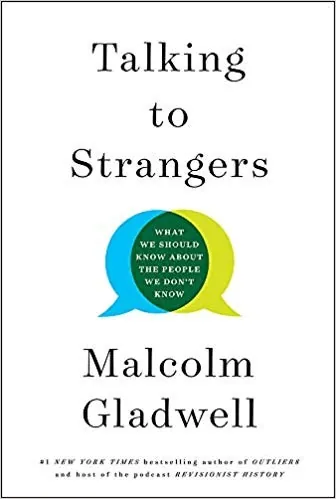
Talking to Strangers: What We Should Know About the People We Don't Know
Listen to it free. Get Talking to Strangers on Audible with a 30-day trial — cancel anytime.
Start listening freeon AudibleNew members only · many titles are included with the membership. As an Amazon Associate, Read Stacks earns from qualifying purchases and membership trials at no extra cost to you.
What this book is, and who it's for
Gladwell's 2019 book is his most uncomfortable. The central question is why humans are so consistently bad at reading strangers — at recognizing deception, at extracting honest accounts, at making accurate judgments about people we've just met. Drawing on cases ranging from Cuban espionage and Bernie Madoff's Ponzi scheme to the Brock Turner trial, Sandra Bland's traffic stop, and the Sandusky cover-up at Penn State, Gladwell builds an argument that the failures are not individual carelessness but structural: humans default to trust because daily life requires it, assume that demeanor reveals interior state when it usually doesn't, and ignore the powerful role of immediate context in producing behavior we then attribute to character. The book is careful and serious about consequential cases, and it does not flatter readers who expect that better training or better instincts would fix the underlying problem. Read this when you've noticed that the conventional advice for reading people — trust your gut, read body language, ask probing questions — keeps failing you in exactly the situations where the cost of failure is highest.
Tim Levine's theory that humans default to trusting strangers because daily life requires it. The default is functional for ordinary cooperation but exploited by skilled deceivers, producing the structural pattern Gladwell catalogs across espionage, finance, and policing.
How to apply Talking to Strangers in 3 steps
- 1Reduce confidence in your reads of strangers
Your gut about a stranger is less reliable than you think. Demeanor doesn't map cleanly to interior state, especially across cultures and contexts. For high-stakes assessments, downweight your in-person impression and upweight track record + structured evaluation.
- 2Build structural defenses against deception
You cannot personally screen for skilled deceivers; the trust default is what makes social cooperation possible. The defense is structural: separation of duties, mandatory reporting, independent review. Build the structures where deception would be costly, rather than relying on personal detection.
- 3Recognize the role of context in stranger encounters
When a stranger encounter goes badly (police stop, customer dispute, family conflict), examine: what role did the immediate context play? Many bad encounters trace to context (location, time, mood) more than to the people involved. Changing the context for repeat encounters often resolves what feels like a person-problem.
Opening
Chapters
- Chapter 1Fidel Castro's Revenge1.5 min
- Chapter 2Getting to Know der Führer1.5 min
- Chapter 3The Queen of Cuba1.5 min
- Chapter 4The Holy Fool1.5 min
- Chapter 5Case Study: The Boy in the Shower2 min
- Chapter 6The Friends Fallacy1.5 min
- Chapter 7A (Short) Explanation of the Amanda Knox Case1.5 min
- Chapter 8Case Study: The Fraternity Party2 min
- Chapter 9KSM: What Happens When the Stranger Is a Terrorist?1.5 min
- Chapter 10Sylvia Plath2 min
- Chapter 11Case Study: The Kansas City Experiments1.5 min
How to read this book. Each chapter is a ~30-second summary — the core insight, no filler. Open the chapters that grab you. If the book resonates, hear the full audiobook free with an Audible trial or buy the edition on Amazon (links below, affiliate-disclosed).
Talking to Strangers pairs well with
A single book is an argument. A stack is a curriculum. Talking to Strangers appears in this curated reading path — each pairs it with other books that sharpen its ideas, in a suggested reading order.
More books like Talking to Strangers
The other books in the curated reading paths Talking to Strangers belongs to. Each one sharpens, extends, or counter-argues something Talking to Strangers establishes — the compound is the reason these books sit together in a stack.
- Master power dynamicsThe Art of WarSun Tzu
- Master power dynamicsThe 48 Laws of PowerRobert Greene
- Master power dynamicsThe Laws of Human NatureRobert Greene
- Master power dynamicsPre-SuasionRobert Cialdini
- Master power dynamicsNever Split the DifferenceChris Voss
- Master power dynamicsAntifragileNassim Nicholas Taleb
- Master power dynamicsSkin in the GameNassim Nicholas Taleb
Frequently asked questions
What is Talking to Strangers about?+
Gladwell's 2019 book is his most uncomfortable.
How long does it take to read Talking to Strangers?+
The full Talking to Strangers typically takes 4-6 hours to read cover-to-cover. The Read Stacks chapter summaries cover the same ideas in ~20.5 minutes total (12 chapters at ~30 seconds each).
Who is Talking to Strangers for?+
Talking to Strangers is widely regarded as essential reading in its field. The Read Stacks summary is the fastest way to decide if the full book is worth your time before committing to it.
What are the key ideas in Talking to Strangers?+
The book covers Fidel Castro's Revenge, Getting to Know der Führer, The Queen of Cuba, The Holy Fool and Case Study: The Boy in the Shower. Each chapter has a free summary on Read Stacks (~30 seconds each).
Is Talking to Strangers worth reading?+
If you're interested in cognitive bias and clearer decision-making, Talking to Strangers is widely considered essential. The Read Stacks chapter summaries help you decide — read the free first chapter, then buy the full book on Amazon if the argument resonates.
Books like Talking to Strangers
If Talking to Strangers resonated, these non-fiction books pick up the same threads.
From Read Stacks · Learn
How to get more out of this book
Two short essays on the meta-skill — what chapter summaries actually preserve, and the six retention techniques that decide whether what you read here is still useful six months from now.
- Are book summaries actually useful, or am I just cheating?
Chapter summaries are a navigation tool, not a substitute. Used right, they help you read more books fully — by helping you avoid the wrong ones. Used wrong, they're a comfort blanket that lets you feel like you're reading without engaging with the material.
6 min read
- I read a lot of books but can't remember anything. What works?
Forgetting most of what you read is normal, not a personal failing — your brain wasn't designed to retain prose at the rate modern readers consume it. The practices that DO work share one thing: they force you to USE the material instead of just consuming it. Six specific techniques, each tested across decades.
7 min read
Appears in these topics
Talking to Strangers is part of this curated reading list — each a “best books on X” cluster with a synthesis on how the books fit together.
Want one curated stack a week in your inbox? Subscribe to the free weekly stack →