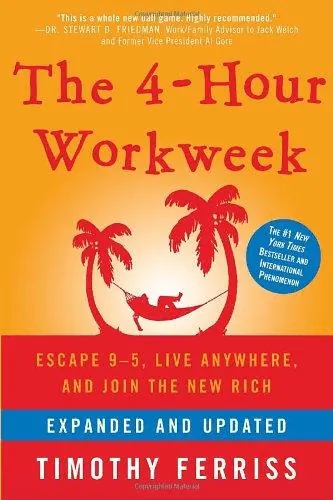
The 4-Hour Workweek: Escape 9-5, Live Anywhere, and Join the New Rich
by Tim Ferriss
Listen to it free. Get The 4-Hour Workweek on Audible with a 30-day trial — cancel anytime.
Start listening freeon AudibleNew members only · many titles are included with the membership. As an Amazon Associate, Read Stacks earns from qualifying purchases and membership trials at no extra cost to you.
What this book is, and who it's for
Tim Ferriss's 2007 book is the founding text of the modern lifestyle-design and digital-nomad movements. The central argument is that the conventional career narrative — work hard for forty years, save aggressively, retire to enjoy life — is structurally backward, deferring everything that makes life worth living to a period when the chooser is least able to enjoy it. Ferriss proposes an inversion: design your work so that the things normally deferred to retirement (extended travel, learning, time-rich pursuits) become accessible immediately, with retirement as one option among many rather than the central goal. The book is organized around the DEAL framework — Definition (clarify what you actually want), Elimination (remove the work that produces no value), Automation (delegate the work that remains), Liberation (use the freed time to live the defined life now). The specific tactics — virtual assistants, muse businesses, the 80/20 elimination, geographic arbitrage, mini-retirements — have been widely copied since publication and the book's framing has shaped the working assumptions of the solo-operator and creator economies that came after. Read this when you've noticed that the trade you are making (your present life for a future life that may not arrive) is a trade you would not consciously choose if you examined it.
Ferriss's frame: reorganize the lifecycle so present life is the project, not the deferred reward of conventional retirement. The DEAL framework (Definition, Elimination, Automation, Liberation) is the operational path.
How to apply The 4-Hour Workweek in 3 steps
- 1Define your dream lifestyle in numbers
Write down what you'd want your daily life to look like in 6 months — where you'd live, what you'd do, what you'd own. Calculate the monthly cost. The number is almost always smaller than the conventional career path is providing, which means the gap is your leverage.
- 2Eliminate ruthlessly, then automate the rest
Apply 80/20 to your work: which 20% of activities produce 80% of valuable output? Eliminate the rest. For what survives elimination, ask: who else can do this for less than my hourly value? Delegate it. The freed time is the project of the rest of the book.
- 3Take a mini-retirement to test the design
Don't wait until 65 to enjoy the life you're optimizing for. Take 3-6 months — sabbatical, geographic move, immersive learning — to live the dream lifestyle and stress-test it. What works, what doesn't, what you actually want changes through the doing. The cycle of mini-retirements compounds.
Opening
Chapters
- Chapter 1Cautions and Comparisons: How to Burn $1,000,000 a Night1.5 min
- Chapter 2Rules That Change the Rules1.5 min
- Chapter 3D is for Definition: Dodging Bullets2 min
- Chapter 4E is for Elimination: The End of Time Management1.5 min
- Chapter 5The Low-Information Diet: Cultivating Selective Ignorance1.5 min
- Chapter 6Interrupting Interruption and the Art of Refusal1.5 min
- Chapter 7A is for Automation: Outsourcing Life1.5 min
- Chapter 8Income Autopilot: Finding the Muse2 min
- Chapter 9Testing the Muse and Avoiding the Black Hole2 min
- Chapter 10L is for Liberation: Disappearing Act2 min
Closing & reference
How to read this book. Each chapter is a ~30-second summary — the core insight, no filler. Open the chapters that grab you. If the book resonates, hear the full audiobook free with an Audible trial or buy the edition on Amazon (links below, affiliate-disclosed).
Frequently asked questions
What is The 4-Hour Workweek about?+
Tim Ferriss's 2007 book is the founding text of the modern lifestyle-design and digital-nomad movements.
How long does it take to read The 4-Hour Workweek?+
The full The 4-Hour Workweek typically takes 4-6 hours to read cover-to-cover. The Read Stacks chapter summaries cover the same ideas in ~21 minutes total (12 chapters at ~30 seconds each).
Who is The 4-Hour Workweek for?+
The 4-Hour Workweek is widely regarded as essential reading in its field. The Read Stacks summary is the fastest way to decide if the full book is worth your time before committing to it.
What are the key ideas in The 4-Hour Workweek?+
The book covers Cautions and Comparisons: How to Burn $1,000,000 a Night, Rules That Change the Rules, D is for Definition: Dodging Bullets, E is for Elimination: The End of Time Management and The Low-Information Diet: Cultivating Selective Ignorance. Each chapter has a free summary on Read Stacks (~30 seconds each).
Is The 4-Hour Workweek worth reading?+
If you're interested in focused work and attention management, The 4-Hour Workweek is widely considered essential. The Read Stacks chapter summaries help you decide — read the free first chapter, then buy the full book on Amazon if the argument resonates.
Books like The 4-Hour Workweek
If The 4-Hour Workweek resonated, these non-fiction books pick up the same threads.
From Read Stacks · Learn
How to get more out of this book
Two short essays on the meta-skill — what chapter summaries actually preserve, and the six retention techniques that decide whether what you read here is still useful six months from now.
- Are book summaries actually useful, or am I just cheating?
Chapter summaries are a navigation tool, not a substitute. Used right, they help you read more books fully — by helping you avoid the wrong ones. Used wrong, they're a comfort blanket that lets you feel like you're reading without engaging with the material.
6 min read
- I read a lot of books but can't remember anything. What works?
Forgetting most of what you read is normal, not a personal failing — your brain wasn't designed to retain prose at the rate modern readers consume it. The practices that DO work share one thing: they force you to USE the material instead of just consuming it. Six specific techniques, each tested across decades.
7 min read
Appears in these topics
The 4-Hour Workweek is part of 2 curated reading lists — each a “best books on X” cluster with a synthesis on how the books fit together.
Want one curated stack a week in your inbox? Subscribe to the free weekly stack →